Looking at vintage photographs of Lodi is like strolling through its past
ByRandy Caparoso
Circa 1860s: Lithograph of the Jacob Brack ranch (est. 1850), a 1,500-acre spread skirting the far west side of present-day Lodi (in the vicinity of N. Jacob Brack Rd. and Interstate 5); note Mount Diablo in the backdrop.
There is an old saying I never quite understood, which goes: “The past is a place to learn from, not to live in.”
Yes, of course, we learn from the past, especially mistakes, big and small. But in many places of the world, we also live in the past. Like people do in Florence, Italy. I distinctly remember being struck by that once, in the late 1980s, when stumbling into the Palazzo della Signoria and suddenly being hit in the head by the real-life—bigger than life—vision of Michelangelo‘s David, created in 1501-1504, still standing in all its naked glory.
Circa mid-1800s, Mokelumne River: Before bridges were built, San Joaquin Valley’s earliest settlers crossed the untamed rives by ferry, such as Benson’s Ferry in the Thornton area (northwest of the City of Lodi near present-day Interstate 5) depicted in this lithograph.
Suddenly I realized, this is an ancient city consumed in timeless edifices and monuments… yet people stroll around this place as if buildings and giant marble statues hundreds of years old were nothing… everyday stuff!
I had similar thoughts when I visited Lodi for the first time, back in 2002. By then I had already been a full-time wine professional for 24 years, and was privileged to have visited most of the greatest wine regions in the world. I thought I knew a good vineyard when I saw it.
Circa 1870s: The Burt & Ivory General Merchandise store first founded in 1869 by Charles Ivory and John Burt near the corner of Pine and Sacramento Streets (across the Central Pacific Railroad depot), playing a key part in the expansion of the city.
But when, for the first time, I brushed up against plants in one of Lodi‘s oldest blocks, consisting of gnarly old vines planted as long ago as the 1880s, and others in the early 1900s, I was thunderstruck, as any wine geek should be by the sight of grapevines still thriving after over 100 years. Living, breathing entities of Nature, still producing wines anybody can drink the way anyone can still stroll among the crowds beneath gigantic statues of David.
1894: Close-up of a a map of San Joaquin County zooming in on the City of Lodi perched along the banks of the Mokelumne River; showing the Central Pacific Railroad line running north-south through the middle of the city, crossing the Sierra Nevada Railroad line going east-west towards San Francisco Bay (through Woodbridge) and the Sierra Nevada (through Victor, Lockeford and Clements).
This is what I would call living in and among the past. The entire Lodi wine region consists of an ever-present, monumental past.
According to Ralph A. Clark’s book Lodi, grapes (albeit, native varieties) were part of the original landscape when early 1800s trappers stumbled on to the place, teeming with gushing rivers, wildlife, grass and towering valley oaks⏤the type of trees that grow only in the deepest and richest of soils, replete with all the fresh water in the world.
1896 and early 1900s: Joe Hinode Co., an anchor of Lodi’s thriving (at the time) Japantown on Main St. running along the east side of the Central Pacific Railroad tracks; the earlier photo (top) showing the wooden building when it was first established in 1896, the bottom showing an expanded brick structure (still standing today); Seijiru “Joe” is seated in the top photo, his wife Yoshino Masui standing to his left (face blurred).
Explorers made note of wild grapevines, “growing wild dangling from the trees along the riverbanks.” The nearby Calaveras River, in fact, was originally called “Wine Creek” by the first settlers of European ancestry. Wrote John C. Frémont during his first expedition to this part of San Joaquin Valley in 1844: “One might travel the whole world over without finding a valley more fresh and verdant⏤more floral and sylvan⏤more alive with birds and animals⏤more bounteously watered⏤than we had left in the San Joaquin.”
Circa early 1900s: Photograph of the Mokelumne River in the Lodi area.
Circa 1800s: Plains Miwok woman with basket woven from riverside reeds and grasses utilized to carry flour made from the acorns of native oaks (representing over 60% of the native diet).
Circa 1907-1909: The majestic Lodi Mission Arch, photographed shortly after the city landmark was erected (for the 1907 Tokay Carnival) and some time before a papier-mâché “golden bear” was placed at the top (in 1909).
But the most significant event of all was the January 1848 discovery of gold in Sutter’s Mill, which unleashed a human flood of settlers coming from across the country, Europe, South America as well as Asia. By the early 1850s many of the newcomers settled into the fertile farmlands along the winding Mokelumne River that would soon become known as Lodi, just a day’s ride by horse or wagon from Mother Lode Country.
1900: Colorized image of Mason Hospital and the home Dr. Wilton Mason—also known as the owner of the city’s first “horseless carriage”—located at 209 N. School St. (approximately where Lodi Stadium 12 Cinemas currently sits).
Point being: Yes, Lodi has become a place for grapes. It is by far the largest commercial winegrowing region in America. But it did not achieve this status only because of the decisions made by settlers and farmers. It found its natural niche because it was already one of the lushest, richest, most fertile places in the New World to grow grapes, and just about any other agricultural crop.
Circa 1900s: The Buck packing shed in Lodi, from which all manner of boxed fruit were shipped across the country via railroad.
It was Mother Nature who dictated Lodi’s fortunes, long before it became Alta California, Nuevo California or just plain “California,” once the territory was finally declared a state (in 1850).
In recent months I have been coming across more and more old photographs that show the history of the way Lodi evolved, once it became an agricultural destination, driven by the region’s natural bounties. Looking through them is like strolling through a past that we most definitely still live in. Hope you enjoy them as much as I do!
1900: Postcard of colorized photo of a Union Pacific Railroad car being loaded with watermelons (because of its rich soils and high water table, Lodi held the unofficial title of “Watermelon Capital of the Country) during the 1880s and 1890s).Circa early 1900s: Harking back to Lodi’s “Wild West” days, the original Lodi Hotel and Bar, a 2-story building located at Pine and Sacramento Streets (where the Lodi Mission Arch would be erected in 1907, and kitty-corner to the train depot); the hotel would be torn down in 1912 and supplanted by the Bank of Lodi (the latter, a building still standing today).1900: City of Lodi train depot (photographed from the balcony of Lodi Hotel), originally established in 1869 by Central Pacific Railroad.1906: George Lawrence, the first mayor of the City of Lodi (incorporated in 1906)l; in Lodi, mayors are appointed by the City Council rather than elected.1907: Electric streetcar operated by Central California Traction Company, connecting Stockton to Sacramento, stopping inf front of the Lodi Hotel during the city’s historic Tokay Carnival.Circa early 1900s: Lodging House (rented out “by the day or week”) on Main Street at Pine Street, on the east side of the railroad tracks.1904 or 1905: The Lodi Opera House, built in 1904 at 10 S. School St. (at W. Pine St.); today, housing Thornton House Furniture.1910: The Southern Pacific Railroad depot; at the time, located north of Pine St. on Sacramento St. (at the current site of the City of Lodi Parking Garage).Circa 1910s: Picture postcard looking east down Pine St. towards the Lodi Mission Arch.1910s: the Lodi Theatre at Sacramento and Elm Streets.1911: The newly erected Pioneer Fruit Company packing shed.1911: Newspaper and magazine ad extolling the benefits of the burgeoning Lodi dairy industry; then and now, among the region’s top four agricultural products.1913: The Lodi Fire Station at 114 N. Main St., which at the time also served as Lodi’s City Hall and jail.1914: A colorized postcard photograph of Lodi’s landmark Mission Arch.1915: Grapes being unloaded from wood crates onto railroad cars at the Lodi train depot, almost all of it destined for El Pinal Winery in Stockton.1915: Colorized picture postcard of the newly unveiled Hotel Lodi at 5 S. School St.1919: The original A&W root beer stand located at 13 Pine St.; founded in Lodi by Roy Allen, who went on to form a partnership in 1922 with Frank Wright, rolling out franchises across the country (starting in 1926).
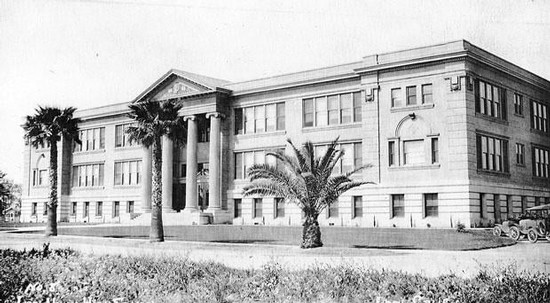
1920 rendering of Lodi Union High School; the main building’s cornerstone originally laid down in 1913 and located on Hutchins St. which, at the time, was still unpaved (like most of Lodi’s streets), sitting at the western edge of the city among vineyards and farms.
Circa 1920s: Lodi postcard boasting the thriving Prohibition era businesses located on Sacramento St. looking north from Pine St.1920s: Train proudly bearing a Woodbridge Vineyard Association banner transporting fresh Lodi grapes to home winemakers all across the country. California State Railroad Museum.1925: Map of City of Lodi in ad for John J. Fink clothing store located in the Hotel Lodi building with a W. Pine St. address.Circa 1930s: Lodi Union High School students.1933: Demonstrating laborers walking across railroad tracks during the ill fated Lodi Grape Strike, promptly put down by local growers and police.1936: Local beauty Inez Jackson posiing with the region’s signature grape Flame Tokay in a publicity shot for Lodi Grape Festival.1937: Another side of Lodi’s history and German influenced lineage, the Pure Sausage & Meat Company located at 630 S. Central Avenue.1938 and 1940s: Richmaid Restaurant servers, originally established as a creamery in 1938 (top photo), and still operating at a S. Cherokee Lane location—for decades while the east side Lodi roadway was still part of Callfornia State Route 99.1940s (top) and 1950s (bottom): Lodi’s School St., the city’s de facto “main drag.”1940s (top) and 1958 (bottom): Blewett’s Ice Cream Fountain, still standing but no longer operating as a meeting place for Lodi families and teens.Circa 1940s: “Slow down… don’t be a killer!” banner hanging over Lodi’s Pine St.1942: Photo by Dorothea Lange of a social worker interviewing an American of Japanese ancestry in the Lodi station of the Wartime Civil Control Administration, prior to the evacuation of families under Civilian Exclusion Order Number 70.1944: Another photo by Dorothea Lange of Japanese-American owned Lodi properties such as this old vine block, documented for the Department of the Interior War Relocation Authority.1944: Postcard view of Lodi Lake Park.1945: The Lodi Union High School basketball team.1950s: Postcard of A&W on E. Lodi Ave., proclaiming the Lodi roots of A&W restaurants.1950s: The historic Lodi Mission Arch.1950s: The Turner St. underpass during the days when the road was still of horse-and-buggy width, and pretty much useless during periods of heavy rain.1953: At City Hall, Lodi Mayor Mabel Richey honors Edith Erhardt as the “most popular and typical girl motorcycle rider.”Circa 1960: Vintage postcard showing off Lodi City Hall, originally erected in 1928 with Renaissance inspired Tuscan brick masonry.1961: Lodi Union High School band marching down Pine St. at the intersection of School St.
1960s: One of the country’s original A&W locations on E. Lodi Ave.
1960s: N. Sacramento St. Freight Depot during the last days of Central California Traction Company (operating until 1966).1960s: City of Lodi police car durning the era of maximum sized tailfins—a ’61 Plymouth festooned by the department’s signature “grape bunch” logo.1966: Lodi News-Sentinel cut-out showing the future site of Lodi’s Public Safety Building (Lodi Police Department) at 2015 W. Elm St., just west of N. Church St.1977: A student standing at the future site of Tokay High School (first founded in 1972), on farmland at Lodi’s Century Blvd. at Ham Lane.
A good weekend starts in Lodi. And from there, the weekend writes itself. Summer in Lodi doesn’t really announce itself; it just settles in. The berries are sizing up on the vine, the light lingers well into the evening, and the Delta Breeze rolls through most nights to take the edge off the afternoon heat….
Where should you go to experience California’s top award-winning wines? The 2026 California State Fair Commercial Wine Competition results point to Lodi. The competition’s top honors, Best of Show Red and Best of Show White, went to Lodi-grown wines. Add in multiple “Best Of California” varietal awards and 182 medals to wines from across the…
Lodi’s tasting rooms reflect a region that has grown far beyond a single defining grape. Alongside its historic Zinfandel plantings, growers have spent decades working with Mediterranean and Iberian varieties that thrive in the same warm days and cool nights. Albariño from cuttings brought directly from Spain, Cinsaut from century-old vineyards, and Tempranillo that reflects…
Have you ever picked up a bottle of wine and looked closely at the label? If you’re tasting in Lodi, chances are you’ve noticed a small green seal on the back of the bottle. It reads CERTIFIED GREEN, and it tells a story that starts long before the wine enters the bottle, one that reaches…
Here in Lodi, we’re all about welcoming you however you arrive. Walk-ins are always invited, and many of our tasting rooms are ready with a pour whenever you show up. And for those times when you want to go a little deeper – celebrate something, learn something, or just spend an afternoon fully immersed –…
Sometimes the best plans are no plans at all. If you find yourself in downtown Lodi on a Saturday afternoon with some time and a thirst for good wine, you’re in luck. These seven tasting rooms prove that exceptional wine experiences don’t require reservations – just show up and let the day unfold. Cellardoor Cellardoor,…